How to Get Recommended by ChatGPT for Local Services

When it comes to get recommended by chatgpt, AI recommendation engines cite businesses whose content, entity signals, and external presence supply verifiable, specific detail. According to SOCi's 2026 Local Visibility Index, ChatGPT recommends only 1.2% of locations and Perplexity 7.4%, versus 35.9% in Google's local 3-pack. Consistent business data, reviews, and structured content drive inclusion.
Key Takeaways
- ChatGPT recommends only 1.2% of business locations, while Perplexity recommends 7.4%, per SOCi’s 2026 Local Visibility Index.
- Google’s local 3-pack delivers visibility to 35.9% of businesses, yet strong Google rankings do not guarantee AI inclusion.
- Inconsistent business data, thin content, and weak review profiles drive AI invisibility across recommendation engines.
- Completing the Google Business Profile, auditing content specificity, and standardizing business details build citable entity signals.
Why Are AI Chatbots Ignoring Your Business?
AI chatbots ignore most businesses because these platforms operate with extreme selectivity. ChatGPT recommends only 1.2% of business locations, while Perplexity recommends 7.4%, according to SOCi's 2026 Local Visibility Index. Traditional search visibility does not guarantee AI inclusion. Strong Google local rankings do not automatically translate into AI recommendations for most companies. ChatGPT processes billions of daily queries, making invisibility on these platforms a direct revenue loss for service-based businesses across Maryland, DC, and Virginia.
How Selective Are AI Search Platforms Compared to Google?
Google's local 3-pack delivers visibility to 35.9% of businesses. ChatGPT's recommendation rate sits at 1.2%. The gap is enormous. A business dominating Google Maps may still remain completely absent from AI-generated answers. The selection criteria differ fundamentally between traditional search and answer engine optimization.
What Prevents a Business from Appearing in AI Recommendations?
Three factors drive AI invisibility. First, inconsistent business data across directories confuses AI models that prioritize verified entity signals. Second, thin or generic content fails to provide the specific, structured information AI platforms need to cite a business confidently. Third, weak review profiles and low engagement metrics signal irrelevance to recommendation algorithms.
Best Fit Digital addresses these gaps through generative engine optimization Baltimore strategies tailored for service businesses. The company's AI search optimization DMV services rebuild the data foundation AI platforms require. LLM visibility demands precise entity management, not just keyword rankings. For small businesses, AI visibility for small business represents the difference between capturing conversational search traffic and losing customers to competitors who appear in those recommendations. Businesses that want to get recommended by ChatGPT must treat AI platforms as distinct channels requiring dedicated optimization, not as extensions of existing SEO efforts.
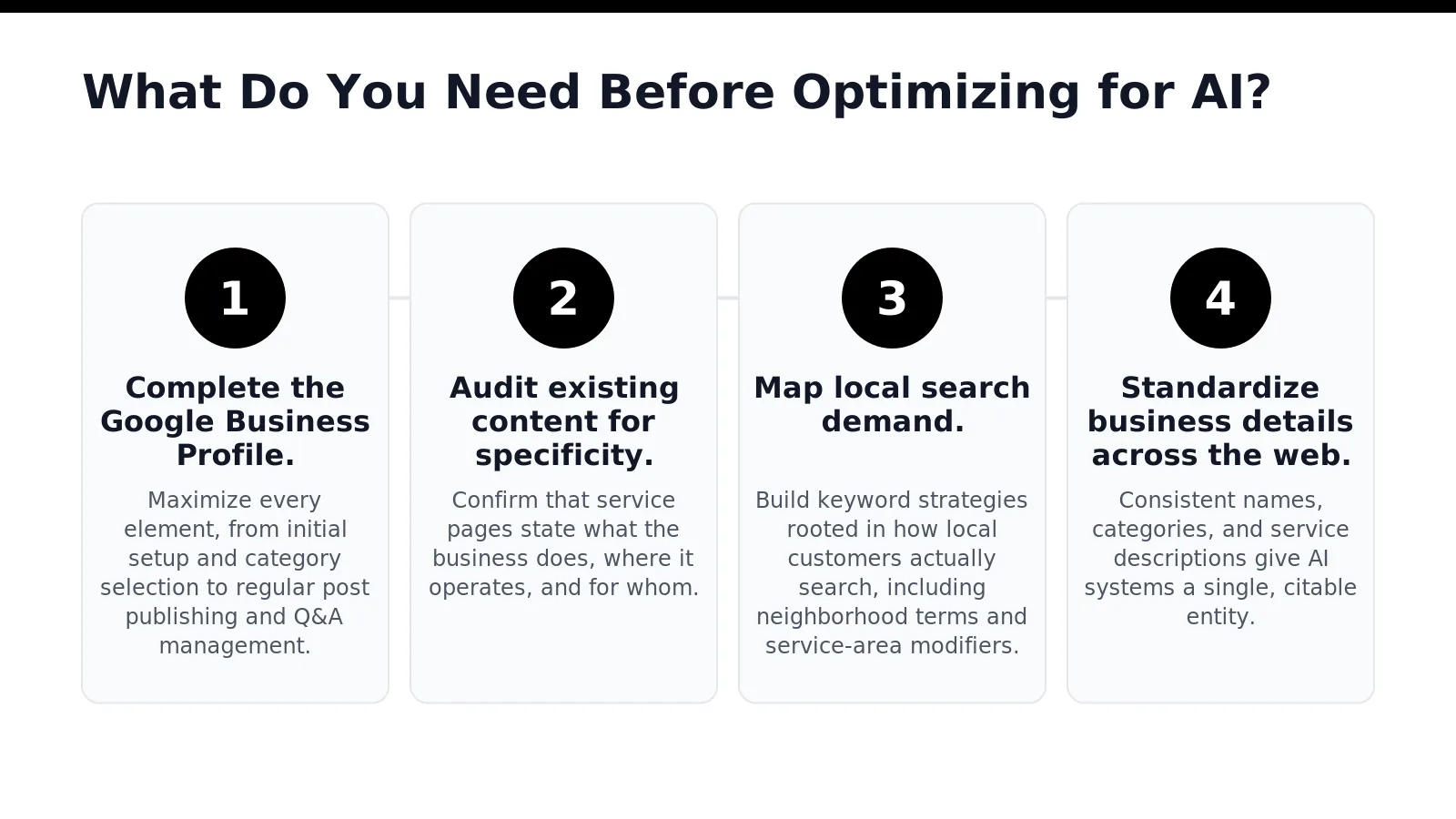
What Do You Need Before Optimizing for AI?

Before optimizing for AI, a service business needs three assets: accurate entity data, verifiable content, and a clear picture of how local customers search. AI platforms draw from multiple sources, including training data and live web retrieval, to generate answers and sometimes name specific businesses. That breadth raises the bar. A business that cannot be verified across sources stays invisible at the moment of recommendation.
Answer engine optimization starts with a foundation, not a tactic. The brands that AI tools name are the ones whose content, entity signals, and external presence give the platform enough verifiable, specific, and credible information to cite with confidence. Weak or conflicting data produces silence.
What Foundational Assets Should a Business Prepare?
- Complete the Google Business Profile. Maximize every element, from initial setup and category selection to regular post publishing and Q&A management.
- Audit existing content for specificity. Confirm that service pages state what the business does, where it operates, and for whom.
- Map local search demand. Build keyword strategies rooted in how local customers actually search, including neighborhood terms and service-area modifiers.
- Standardize business details across the web. Consistent names, categories, and service descriptions give AI systems a single, citable entity.
How Does Local Search Demand Shape AI Visibility?
AI visibility for small business depends on matching real query patterns. Best Fit Digital builds keyword strategies around neighborhood terms, service-area modifiers, and competitive gap analysis. That groundwork supports generative engine optimization Baltimore and AI search optimization DMV engagements, where LLM visibility follows from clean data and credible content. Businesses that skip this step lose recommendations they never see reported.
How Do You Build Entity Signals for LLMs?

Building entity signals for large language models requires a systematic approach to data consistency and structured information. Each AI tool discovers and recommends businesses differently, with ChatGPT drawing primarily from its training data, a snapshot of the web built over years of crawling. Without deliberate signal construction, service businesses remain invisible when prospects ask conversational AI platforms for recommendations.
What foundational elements strengthen entity recognition?
Three core components form the backbone of entity signal strength. First, Google Business Profile optimization establishes the primary entity record that AI models reference. Second, consistent citation building across directories and platforms reinforces the business's identity signals. Third, active review management practices generate the fresh, authentic content that LLMs interpret as credibility indicators. Mastering these local SEO nuances provides a competitive edge, ensures a higher conversion rate, and fosters improved brand awareness across both traditional and AI-driven search environments.
How do local rankings influence AI recommendations?
Strong local search performance creates the data foundation that AI models draw upon when generating recommendations. Best Fit Digital ensures businesses appear at the top of the Map Pack, the organic results, and everywhere in between. This comprehensive visibility feeds consistent entity data into the broader web ecosystem. AI platforms then encounter the same verified business information across multiple authoritative sources, strengthening the confidence level behind any recommendation. The result is a self-reinforcing cycle where traditional local SEO excellence directly fuels LLM visibility and answer engine optimization outcomes.
What Content Makes AI Cite Your Service?

AI platforms pull from multiple sources to build an answer, then name the businesses those sources describe with confidence. ChatGPT, Perplexity, Gemini, and Google AI Overviews summarize information from across the web and sometimes mention specific businesses. Content earns a citation when it states a service, a location, and a proof point in plain, verifiable language.
Answer engine optimization starts with structure. Each page should answer one question directly, then support that answer with specifics an AI system can extract and repeat.
What Content Structure Helps AI Systems Cite a Business?
Write for extraction first. A service page that opens with a clear, factual statement about what the business does and where it operates gives an AI model a clean sentence to quote. Supporting detail follows in short paragraphs, with headings that match how buyers phrase their questions. Best Fit Digital builds strategies, content, and consistent optimization that get a business found on Google and chosen by buyers. That same discipline carries into LLM visibility, where clarity and repetition of core facts matter more than volume.
How Should a Service Business Build Content for AI Visibility?
Follow a repeatable process:
- Map the questions buyers actually ask, including neighborhood and service-area terms.
- Write one direct answer per page, stated in the first two sentences.
- Add proof: service details, coverage areas, and verifiable business facts.
- Publish consistently so AI systems encounter the same facts across sources.
AI visibility for small business depends on this consistency. Best Fit Digital builds keyword strategies rooted in how local customers actually search, including neighborhood terms, service-area modifiers, and competitive gap analysis unique to the market. The company also provides a comprehensive roadmap for sustainable search rankings tailored to local businesses.
For firms pursuing generative engine optimization Baltimore and AI search optimization DMV markets, the payoff is straightforward. Content that answers clearly gets summarized, and summarized content gets named. Businesses that want to get recommended by ChatGPT should treat every service page as a source document worth citing.
What Mistakes Hurt Your AI Search Visibility?

AI search visibility collapses when businesses treat these platforms like traditional search engines. Google AI Overviews now appear on around 25% of all searches, according to LocaliQ's 2026 analysis, yet most service businesses remain invisible to ChatGPT, Perplexity, and Gemini. The cost of invisibility compounds daily as prospects ask AI tools for recommendations and receive competitor names instead.
Why does strong Google ranking fail to transfer to AI platforms?
Traditional local SEO success does not guarantee AI visibility for small business owners. AI models evaluate entity signals, content depth, and citation consistency differently than Google's ranking algorithms. A business dominating the local 3-pack often lacks the structured data and authoritative mentions that large language models require for confident recommendations. The gap widens for multi-location brands. These organizations face a scale challenge where maintaining accurate data, consistent reviews, and optimized content across every location becomes unmanageable without automation.
What operational gaps block LLM visibility?
Three specific failures prevent businesses from appearing in AI-generated answers:
- Inconsistent business data across directories. AI models cross-reference multiple sources. Conflicting addresses, phone numbers, or hours signal unreliability and suppress recommendations.
- Thin or generic website content. AI tools extract specific, verifiable information. Vague service descriptions provide nothing for models to cite with confidence.
- Neglected review velocity and response patterns. Stale reviews and absent owner responses indicate an inactive business, reducing the likelihood of AI recommendation.
Answer engine optimization demands continuous data accuracy and content freshness. Best Fit Digital addresses these gaps through performance-based, month-to-month services that maximize ROI without long-term contracts. The company's boutique approach provides direct access to senior strategists who understand the DMV market intimately, including Baltimore's competitive landscape. For service businesses pursuing generative engine optimization Baltimore strategies, this specialized guidance prevents the operational drift that erodes AI search presence.
FAQ
Why do AI chatbots ignore most local businesses?
ChatGPT recommends only 1.2% of business locations and Perplexity 7.4%. Inconsistent data, thin content, and weak review profiles drive this invisibility.
What prevents a business from appearing in AI recommendations?
Three factors: inconsistent business data across directories, thin content, and weak review profiles. These confuse AI models and signal irrelevance.
What do you need before optimizing for AI?
Accurate entity data, verifiable content, and a clear picture of how local customers search. AI platforms require verified, citable signals across multiple sources.
Conclusion

Getting recommended by ChatGPT, Gemini, and Perplexity requires a deliberate shift from traditional search optimization toward answer engine optimization. Service businesses that structure content for extraction, maintain consistent entity data across authoritative sources, and publish verifiable service details position themselves for citation rather than invisibility. The decision to implement these practices determines whether an AI platform names a business as a trusted local option or passes over it entirely.